The Colbert Effect: What Instagram Data Reveals About What Democrats Want
Two viral-native Democrats are competing in the first marquee primary of the 2026 cycle. A censorship fight with Donald Trump did more for audience growth than weeks of intra-party political controversy.
The 2026 Texas Senate Democratic primary is a natural experiment in digital campaigning. Two young, high-profile, Democratic candidates with a seemingly instinctual understanding of how to communicate in the modern media environment not only facing off against one another, but finding themselves at the center of controversies that reflect the appetite of voters one year into Trump’s second term.
Looking at instagram performance data (followers, likes, comments) across a 6.5 month panel window, a clear story emerges about what drives support online, and potentially, on Election Day.
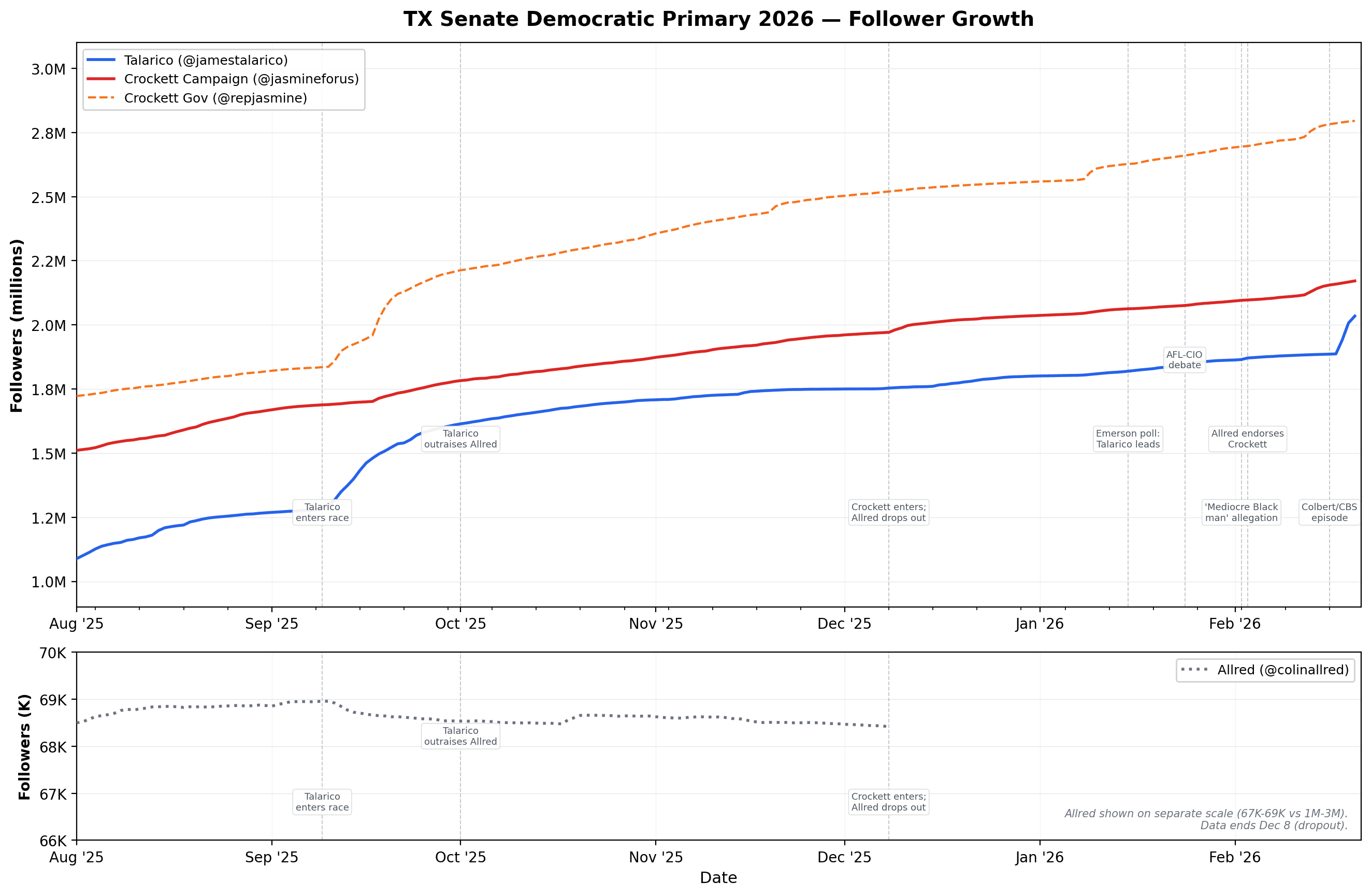
The Colbert-FCC controversy defines the online trajectory of this race. Talarico's YouTube-only Colbert episode end ensuing content about the FCC's censorship attempts produced a surge of +149,154 followers across the next five days. His daily follower gain jumped from a baseline of roughly +917/day to +29,831/day: a 32x increase. No other event in the race comes close for either candidate.
For context, other key race moments such as the AFL-CIO debate, the Emerson poll, Allred's endorsement of Crockett, and even the musch discussed Talarico-Allred controversy, only produced shifts of +300–900 followers per day. Baseline growth during the two-candidate phase was roughly +2,000/day for both candidates. If we take changes in the rate of follower growth to signal changes in voter awareness, these events didn't move the needle.
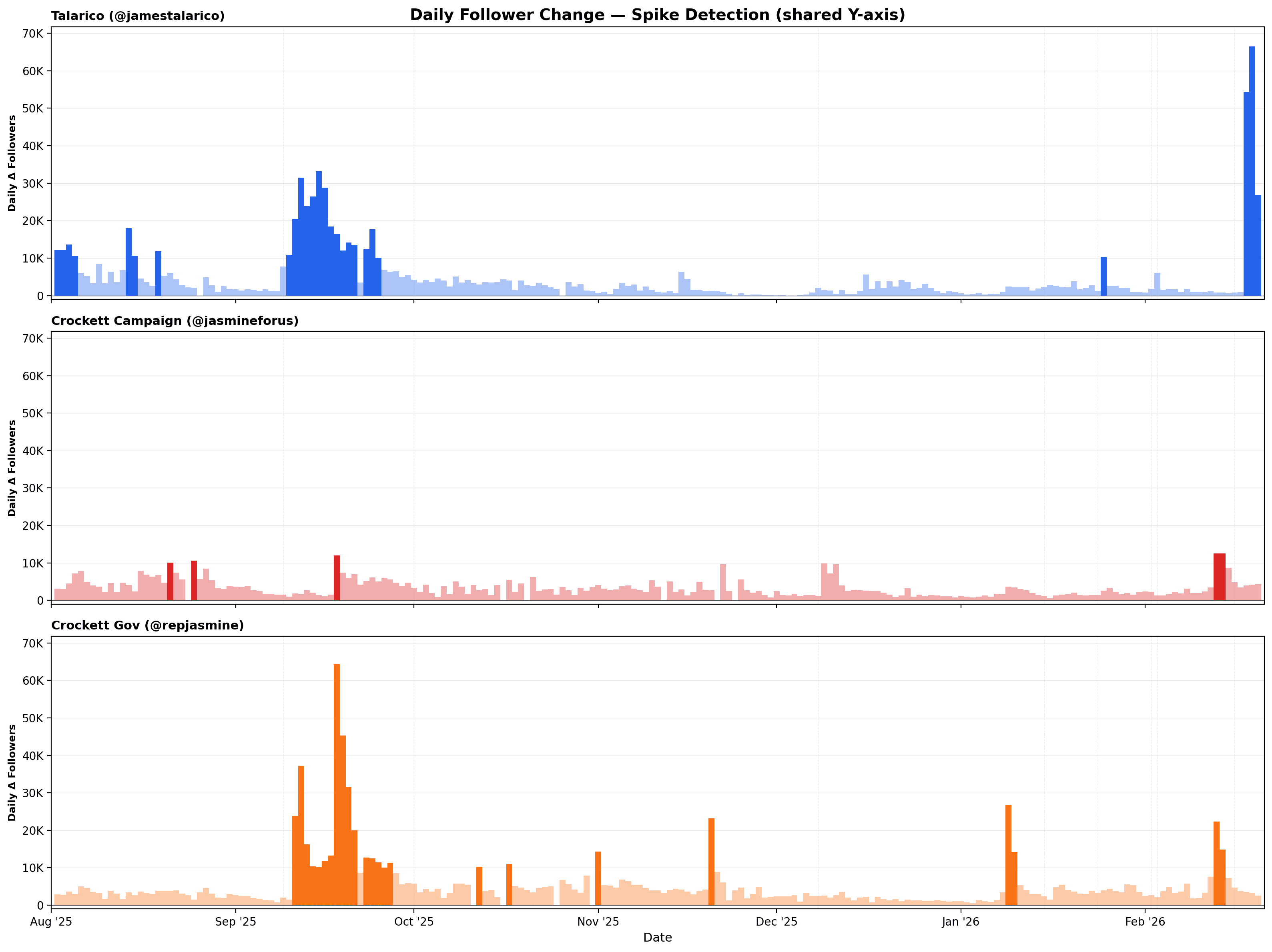
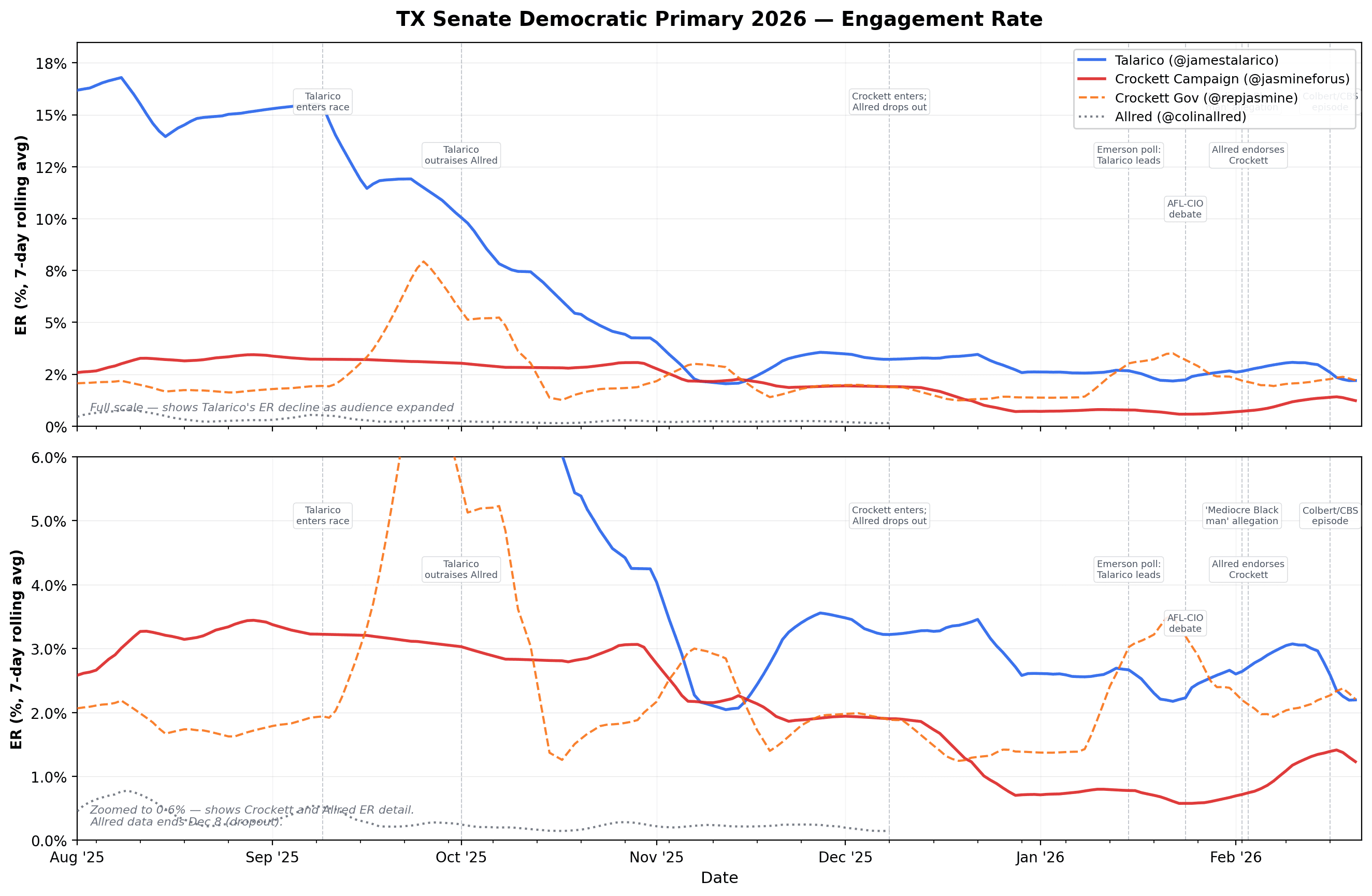
Platform growth is only one metric, and the Crockett campaign has maintained that they are running a turnout camapign, not a persuasion one. From this perspective, one might be tempted to de-prioritize growth and instead focus on engagement. The "mediocre Black man" allegation and Allred's subsequent endorsement of Crockett dominated political media coverage for nearly two weeks. And while the growth impact on Instagram was negligible (Talarico's daily change went from +1,715 to +2,078. Crockett's went from +2,193 to +1,944), Crockett's engagement spiked up 51%.
However, the Congresswoman's increased engagement rate should not be interpreted as a sign she is running a stronger online base-amplification-campaign while Talarico is fighting for new audiences and new voters at the expense of base engagement. Talarico still leads on engagement rate. His average ER across the panel window (6.54%) exceeds both Team-Crockett accounts: 3.1x higher than her campaign account (2.10%) and 2.7x higher than her government account (2.46%).
The caveat: The panel data tracks engagement rate as the average number of likes and comments divided by the total number of followers - not viewers. Talarico started with fewer followers, which naturally inflates his engagement rates. But two things cut against dismissing the gap entirely. First, it suggests his organic reach is disproportionate to his follower count, with fewer followers, he's reaching a comparable number of voters. Second, even as he's caught up in follower growth, he's still averaging 1.5–2.5x higher engagement rates than Rep. Crockett.
Takeaway: The Colbert appearance and related discourse expanded Talarico’s audience. The Talarico-Allred controversy activated Crockett’s existing base, but didn’t grow it, and not enough to overtake the Talarico campaign’s engagement machine.
What does this say about the nature of the controversies Democrats care about in Trump 2.0? One critical reading of the Talarico-Allred controversy is that its failure to resonate with a broader audience is indicative of Democratic voters' ambivalence towards taking seriously the claims of bias, racism, and sexism within our own house. The other reading is that there is a large audience uninterested in engaging with a disingenuous weaponization of identity politics to further the careers of moderate Democrats at the expense of new, progressive entrants into the political arena.
This Rorschach test may not matter at the end of the day. Talarico vs. Trump's FCC brought new followers into his fold. Talarico vs. Allred did not send any to Rep. Crockett's. Trump 2.0 animosity may simply be the most powerful online force, despite the brewing leftist vs. liberal proxy war that will certainly continue throughout the remainder of his presidencey.
During the September 9 – December 8 period when Talarico and Allred were both notionally in the race, Talarico gained +466,820 followers. Allred lost 549. Allred posted 4.2x more frequently (2.16/day vs. 0.50/day) but had 27x lower engagement (0.22% vs. 5.98% ER).
The social data signaled his inability to compete months before his formal withdrawal.
The closing weeks of the primary will reveal whether the Colbert surge sustains or decays, and whether Crockett's campaign strategy translates into a turnout advantage that Instagram metrics can't capture.
If you thought this insight was helpful, please consider subscribing to my Substack so you don't miss future posts. And if you want access to Context, the research tool I built that powered this analysis, drop me a line.
Methodology: Panel window: August 2025 – February 20, 2026. Engagement rate = (avg likes + avg comments) / followers. Growth attribution uses mean + 2σ spike detection. This is a three-account case study — no statistical generalization is possible. Instagram only; excludes TikTok, where Talarico also has significant reach. Cannot causally attribute growth to events; associations are temporal, not causal. Crockett's combined follower count overstates unique reach due to unknown cross-account overlap.